A material-specific scanning approach
We do not scan books, newspapers, manuscripts and historical documents the same way; we choose the right equipment and resolution for each material.

We turn your books, newspapers, manuscripts and historical documents into a long-lasting, searchable digital collection using scanning techniques, colour accuracy and archival standards suited to each material.
Let’s discuss your project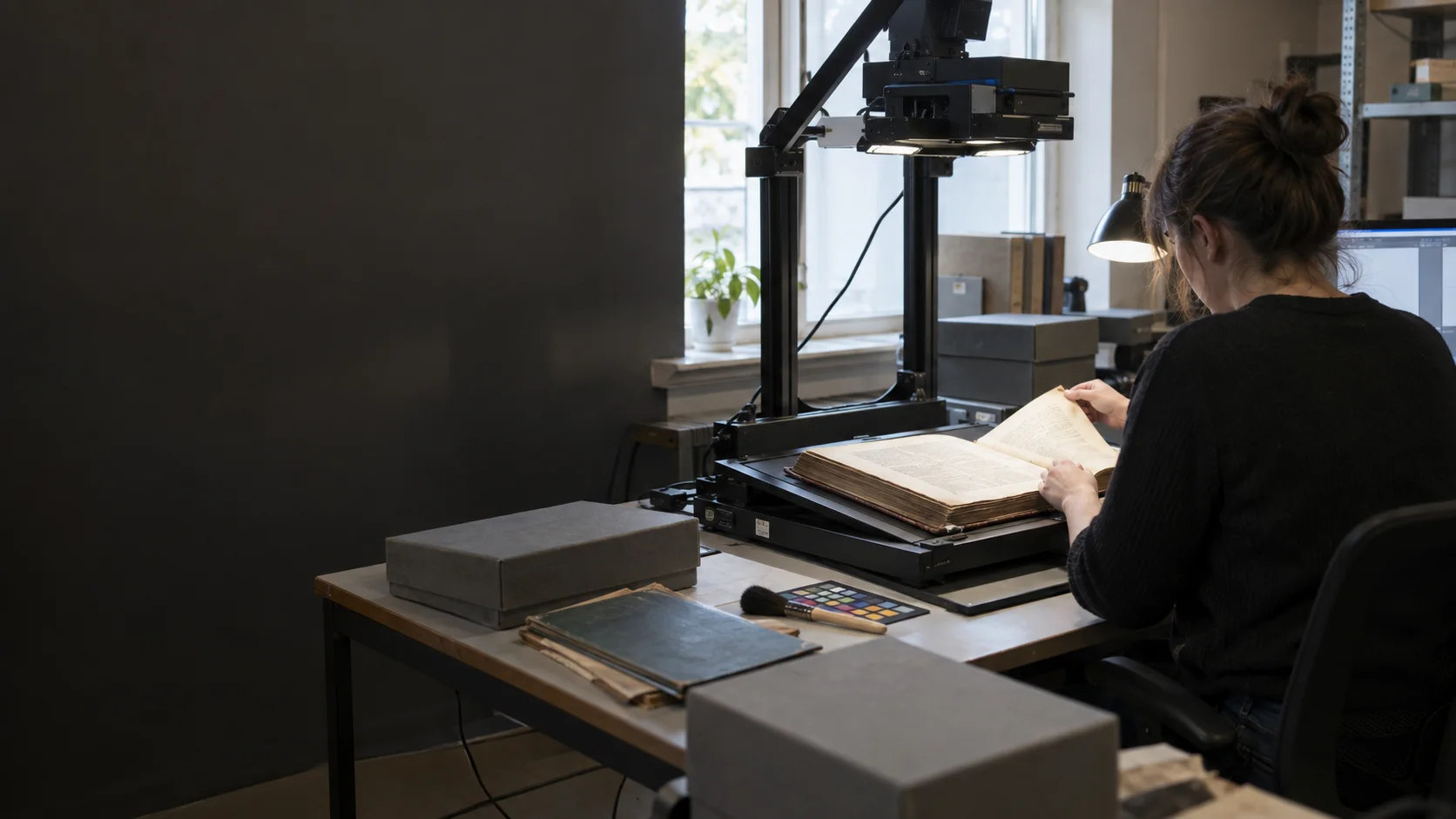
When books, newspapers and manuscripts are digitised with the same scanner and the same resolution, bindings get damaged, newspaper pages warp, or handwritten detail becomes illegible.
Books, newspapers, manuscripts and historical documents may all fall under the heading of "paper", but each requires a different scanning method, a different resolution and a different conservation approach. We plan our book digitisation, newspaper digitisation, manuscript digitisation and historical document digitisation work according to each material’s binding, paper structure and condition.
We do not scan books, newspapers, manuscripts and historical documents the same way; we choose the right equipment and resolution for each material.
For fragile and sensitive materials, we use methods that minimise light, heat and physical pressure.
We deliver in long-lasting formats such as TIFF, PDF/A and JPEG2000, together with Dublin Core-compatible metadata.
We offer a holistic process, run by the same team, from physical archiving through to digital archiving.
Book digitisation requires scanning a bound work without stressing its spine, so we use overhead scanners and book cradles, set angle and lighting to the page’s natural resting position, and correct page curvature in software after capture to make the text OCR-ready. Newspaper digitisation, by contrast, is shaped by large formats and brittle, often acidic paper; pages are typically scanned in grayscale at 300–400 DPI using large-format flatbed or overhead scanners with additional support surfaces, and archival master files are stored as high-resolution, uncompressed images.
Manuscript digitisation is conservation-first: works are exposed to as little light and heat as possible, and calibrated light sources and colour reference cards are used for colour accuracy; where faded, stained or illegible text needs to be recovered, advanced techniques such as multispectral imaging are used. In historical document digitisation, official records such as decrees, charters and registers are scanned in a way that preserves both visual integrity and content, described with Dublin Core-compatible metadata fields, and delivered in long-lasting archival formats such as TIFF, PDF/A and, where needed, JPEG2000.
We digitise bound books and periodicals using overhead scanners and book cradles, without putting pressure on the spine. Post-capture curve correction and OCR make the text searchable; for rare or fragile bindings, angle and pressure are adjusted specifically for the work.
We digitise large-format, acidic and brittle newspaper collections using large-format scanners, typically at 300–400 DPI in grayscale. Page-level images are linked with METS/ALTO structural metadata, the accepted standard for newspaper collections, making content accessible at both issue and page level.
Handwritten works are scanned through a conservation-first process that minimises light and heat exposure, using equipment calibrated for colour accuracy. For faded or illegible text, advanced techniques such as multispectral imaging can be used, where appropriate, to help recover the content.
We scan official historical documents such as decrees, charters and registers in a way that preserves original size and colour integrity, and describe them using Dublin Core-compatible fields. Outputs are delivered in TIFF, PDF/A and, where needed, JPEG2000 for long-term access.
An auditable, sustainable scope scaled to your needs.
Every step is documented; scope and quality criteria are agreed at the start of the project.
The binding structure, paper condition and level of damage of the book, newspaper, manuscript or historical document are examined, and the appropriate scanning method is determined.
Necessary protective measures are taken for fragile or sensitive materials, with a basic conservation assessment carried out before scanning.
Books are scanned on a book cradle, newspapers on a large-format scanner, and manuscripts and historical documents with conservation-first equipment.
Images are checked for resolution and colour accuracy, then enriched with OCR and defined metadata fields.
Digital outputs are securely transferred, in long-lasting formats, to the target digital archive or delivery medium.
It covers four distinct material types — book digitisation, newspaper digitisation, manuscript digitisation and historical document digitisation — each with a scanning method, resolution and archival standard suited to its structure.
Newspapers are fragile because they are large-format and made from thin, often acidic paper; unlike low-resolution photocopying, this calls for large-format scanners, 300–400 DPI grayscale archival resolution, and page/issue-level structural metadata (similar to METS/ALTO).
Manuscripts are scanned in a conservation-first setup that minimises light and heat exposure, using equipment calibrated for colour accuracy; pages are photographed without strain, at an angle and with support suited to the work.
In some cases, advanced techniques such as multispectral imaging, which captures images across different wavelengths, can improve the readability of faded or illegible text; the suitability of this method is assessed case by case.
Yes. OCR technology makes materials written in the Latin alphabet fully searchable; for historical and handwritten texts, feasibility is assessed based on legibility and script type.
For long-term access we typically use TIFF and PDF/A, with JPEG2000 also used for large newspaper collections; other output formats are supported on request.